


Sep 7, 2026 9:22 AM
Updated Sep 8, 2026 9:18 AM
August put crvUSD’s monetary policy through a full cycle, expanded productive collateral in Llamalend V2, and gave the DAO a new risk provider.
This article was originally published by Curve on Curve News.Key highlights of August
- crvUSD's monetary mechanism completed a full cycle: PegKeeper supply expanded, minting got cheaper at 1.55%, borrowers minted, and PegKeepers returned most of the temporary supply
- Borrower-minted crvUSD grew 97% to $72.2M, backed by $146.4M in collateral. A single wstETH position accounted for over half of the growth
- Llamalend V2 added svZCHF as its first Swiss-franc collateral, while the sreUSD market's crvUSD cap doubled to $30 million. Both svZCHF and sreUSD continue earning yield while used as collateral
- yRisk was selected as the DAO's risk provider in August, and the vote funding the mandate executed on 2 September
crvUSD borrowing grows as interest rates fall
 Curve Monthly Recap August 2026
Borrower-minted crvUSD grew from $36.7M to $72.2M in August, a 97% increase. Most of that growth came late in the month, after PegKeepers had expanded supply and minting had become cheaper.
PegKeepers add crvUSD when their pools have too little of it relative to the paired stablecoin, as low supply creates upward pressure on its price. By supplying crvUSD, they help rebalance the pools and keep trading close to the dollar peg. In August, a temporary surge in demand pulled significant amounts of crvUSD from the stable pools, with YieldBasis-related trading accounting for a large share of the observed flows. PegKeeper debt consequently increased from $33.75M on 18 August to $108.2M on 24 August.
That expansion helped reduce borrowing costs for crvUSD. PegKeeper debt feeds into the rate model, which lowers minting rates as the PegKeeper debt share increases, encouraging borrowers to add collateral-backed crvUSD supply. Borrower minting increased sharply on 25 August. Over the following days, PegKeepers withdrew part of their temporary supply, ending the month with $42.2M outstanding. The debt-weighted average mint-market borrow rate closed August at 1.55%, compared with 1.98% at the end of July.
Collateral backing borrower-minted crvUSD also increased 108% to $146.4M, bringing the aggregate collateral-to-debt ratio from roughly 1.92x to 2.03x.
Hourly crvUSD prices averaged $0.99991 and ranged from $0.99966 to $1.00061, staying within 6.1 basis points of the dollar peg across those observations.
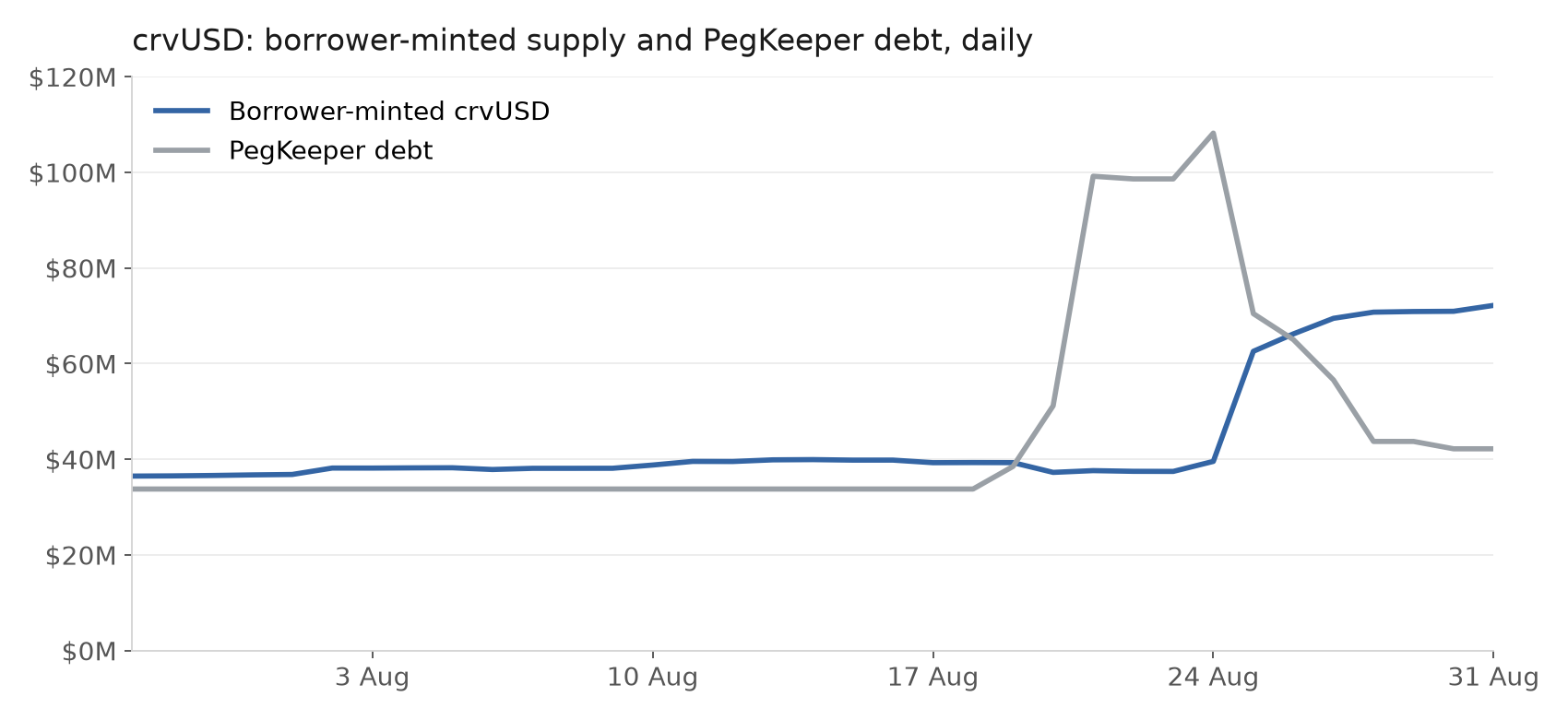 Borrower-minted crvUSD and PegKeeper debt comparison during August 2026. PegKeeper debt peaked at $108.2M on 24 August before falling to $42.2M, while borrower-minted crvUSD rose to $72.2M.
100M in PegKeepers. Mint borrow rates on LlamaLend are about to go down pic.twitter.com/2e5jXPgrUJ— Curve Finance (@CurveFinance) August 22, 2026
Llamalend V2: borrowing against productive collateral
Llamalend V2 continued to grow in August, with more capacity to borrow against yield-bearing assets. These markets let users keep earning on their collateral while borrowing crvUSD to increase their exposure through leveraged yield farming. Borrowers can also use the funds elsewhere without selling the asset.
The svZCHF/crvUSD market opened on 12 August with a 500K crvUSD borrow cap, introducing Swiss-franc-denominated collateral to Llamalend. svZCHF is Frankencoin’s savings token and earns the Swiss franc savings rate while posted as collateral. Holders can borrow crvUSD to buy more svZCHF or use the funds elsewhere while retaining their Swiss-franc position.
The sreUSD market’s crvUSD borrow cap doubled from $15M to $30M on 17 August. sreUSD is Resupply’s yield-bearing savings token for reUSD. The higher cap creates more borrowing capacity for users holding sreUSD as collateral.
In a 1 September update, Resupply explained how these markets can be combined for leveraged yield farming. Users lend crvUSD into supported Llamalend V2 markets, including sDOLA, sfrxUSD and syrupUSDC, and use the resulting lending position as collateral on Resupply to borrow reUSD. The position continues to earn lending yield and incentives.
The borrowed reUSD can then be deposited into sreUSD, which can be used as collateral on Llamalend to borrow crvUSD. That crvUSD can fund another lending deposit, allowing the process to repeat. Convex is directing incentives towards these Resupply-related Llamalend markets.
On the Llamalend side of these strategies, LLAMMA gradually converts collateral into the borrowed asset as its price enters the loan’s liquidation range. It can convert that asset back into collateral if prices recover. Soft-liquidation losses and hard liquidation remain possible, and each additional loop increases leverage.
Across all Llamalend V2 markets, borrowing rose 45% to $65.2M during the month, with collateral up 49% to $79.3M.
Annual CRV emissions now below 100 million
CRV entered epoch 6 on 12 August, six years after the token launched. The scheduled 15.9% emission reduction brings annual issuance to approximately 97.2M CRV, compared with 115.5M in the previous epoch. Annual emissions are now below 100M for the first time. That means roughly 18.4M fewer CRV will be issued over the coming year, with annual issuance equivalent to 4.03% of total supply, compared with 4.80% previously.
CRV’s fixed emission schedule reduces the rate each year, halving it every four years. The reduction does not require a governance vote. Once an epoch ends, anyone can trigger the scheduled update through the token contract.
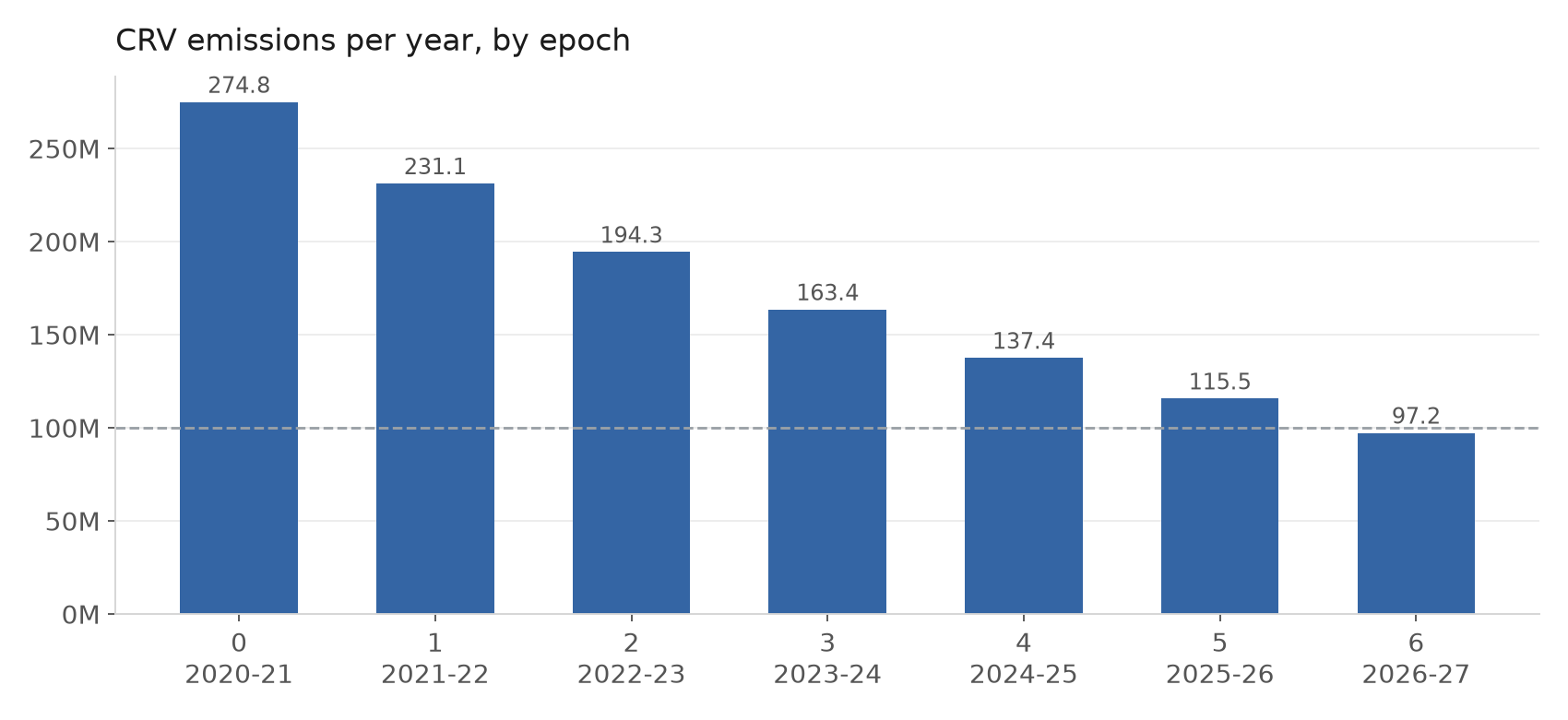 Bar chart showing annual CRV emissions falling across seven epochs, from 274.8M CRV in 2020–21 to 97.2M CRV in epoch 6 for 2026–27.
Emissions are now below 100M CRV per year.
Happy 6th birthday CRV!https://t.co/EdOWC66RNK pic.twitter.com/Pwm8N99pkI— Curve Finance (@CurveFinance) August 13, 2026
Brazilian and Argentine FX markets launch on Curve
Twin Finance's Latin American FX markets went live on Curve on Arbitrum, starting with BRAt and ARGt, putting Brazilian and Argentine spot FX onchain.
Introducing FX LatAm markets on @arbitrum
Access @twinfinance_ stablecoin markets through @CurveFinance.
Starting with BRAt 🇧🇷 and ARGt 🇦🇷, with more coming soon.
Anyone, anywhere can now access the region’s spot FX and credit markets, fully onchain. pic.twitter.com/X8fdHL23Bw— DAMM Capital (@DAMM_Capital) August 27, 2026
As FX pairs behave differently from crypto pairs, it is recommended to tune parameters for each market ahead of deployment, particularly around fees and liquidity concentration. Curve contributors can support partners with this calibration to help ensure pools are configured appropriately for the characteristics of the underlying market.
Governance: yRisk selected as risk provider
Curve DAO selected yRisk as its primary risk provider for crvUSD and Llamalend in August. Its proposal received 537M veCRV in favour and no votes against. The team includes core contributors to Yearn and Resupply, with experience developing and operating Curve and Llamalend integrations.
yRisk will assess new markets and monitor existing ones, with automated alerts, parameter recommendations and incident support. The mandate covers crvUSD mint markets, PegKeepers and Llamalend isolated markets, supported by public methodologies and open-source tooling. This adds another layer of risk oversight, but does not make individual markets risk-free or guarantee that losses cannot occur. Curve governance and the eDAO remain responsible for decisions and execution within their respective roles.
The funding vote was executed shortly after month-end, on 2 September. It funds a one-year mandate through two revocable streams: 125,000 frxUSD held in sfrxUSD and 568,181 CRV. Any additional funded scope would require separate DAO approval.
Separately, Swiss Stake published its H1 2026 progress report in August, covering work under the Curve ecosystem grant. The report confirmed plans to submit a governance proposal to increase the DAO’s share of protocol fees from 10% to 30%.
Around the ecosystem
- Inverse Finance opened FiRM markets taking reUSD/sDOLA Curve LP tokens as collateral, so an LP can borrow against a position that is still earning Curve trading fees
- Zerion shipped an AI-assisted withdrawal flow for Curve positions, with the user reviewing and signing every transaction, which gives Curve LPs an exit route outside the Curve front end
- Convex moved DAO proposals and gauge votes fully onchain, so the vlCVX bloc that directs a large share of CRV emissions now votes onchain rather than off it
- Curve received an AA grade and a score of 52.94 in the inaugural Universal Token Ratings cohort. The DefiLlama and Forgd initiative evaluates project disclosures and live market data.
- Upbit added CRV/KRW and CRV/USDT trading pairs.
Another notable event occurred on 1 September, with YieldBasis raising the deposit caps on its two largest BTC markets from approximately $32M and $43.5M to $50M each, adding roughly $24.5M of deposit capacity. Both markets had been at their caps before the increase.
At 2x leverage, each $50M deposit cap corresponds to a $100M crvUSD allocation. The increases therefore allocated approximately $49M more crvUSD from YieldBasis’s existing factory reserve to the two markets, about $36M for one and $13M for the other.
The month in numbers
DEX TVL ended August at $1.45B, up 6.3%. Pools processed $3.19B in volume and generated $3.04M in gross trading fees, 2.8% more than in July. Four weekly distributions paid approximately $367K to veCRV holders, and CRV locked in Voting Escrow held near 850.2M.
What to watch for next month
More Llamalend V2 markets and further FX pilots are expected, with yRisk now assessing proposed markets and recommending parameters for the DAO to vote on. The numbers to watch are whether borrower-minted crvUSD holds at its new level, and whether the newer collateral markets draw borrowers rather than just sit on capacity. crvUSD supply and the peg will also move with PegKeeper activity and demand from YieldBasis, alongside wider market conditions.
Comments

Powered by RoundtableBuilt on infrastructure designed for real-time media. Learn more at RTB.io.© Roundtable 2026. By using this site you agree to the Terms of Use and Privacy Policy